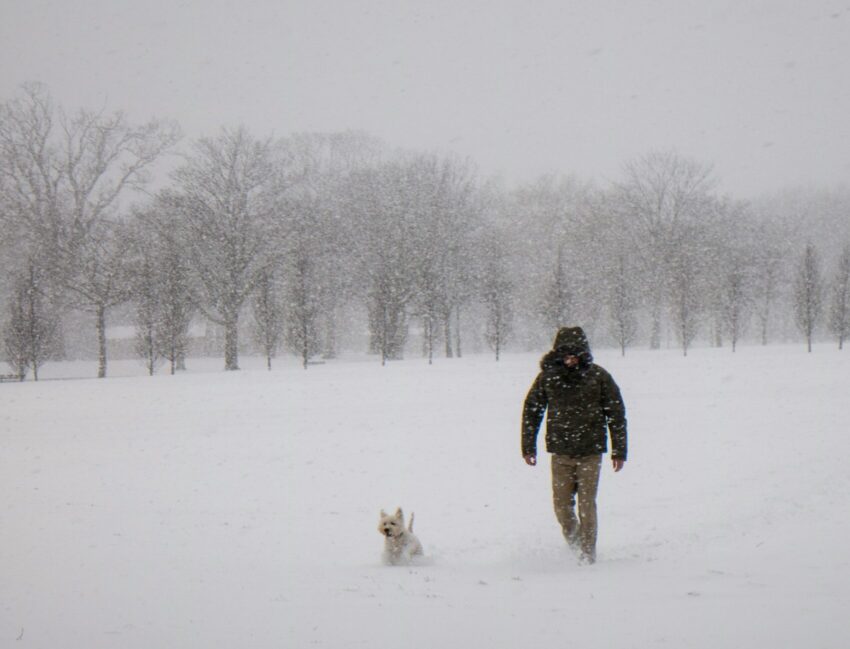
I live in southern China, where snow is rare. Yet I saw snow with my own eyes this year in the Shennongjia Scenic Area. Snow was white and cold. Everything—mountains, trees, cars, people—was covered in white. It felt remote, isolated. Snow’s white is a trick of perception. It reflects all colors, but our eyes see it as white. The whiteness of snow can bring spiritual or emotional blindness, according to Psychology Today. In most literature, snow is often associated with death. I want to try a different reading. Snow can symbolize blindness. I explore this through James Joyce’s The Dead.
Snow symbolizes Gabriel’s blindness.
1. Gabriel’s blindness to his own self-image
“Is it snowing again, Mr Conroy?” asked Lily.
……
“O, then,” said Gabriel gaily, “I suppose we’ll be going to your wedding one of these fine days with your young man, eh?”
The girl glanced back at him over her shoulder and said with great bitterness: “The men that is now is only all palaver and what they can get out of you.”
Gabriel colored as if he felt he had made a mistake and, without looking at her, kicked off his goloshes and flicked actively with his muffler at his patent-leather shoes.
This moment shows Gabriel performing warmth while failing to hear the truth in Lily’s frustration. He assumes a flattering, almost masculine pride, and his color change signals shame not only at his behavior but also at being seen for what he is: a man who uses charm for social leverage. The snow here is a social whiteout— Gabriel’s self-image is revealed as fragile polish. He misreads power in the room and hides behind courtesy, missing the younger voice that cuts through his performance.
2. Gabriel’s blindness to his suppression
How pleasant it would be to walk out alone, first along by the river and then through the park! The snow would be lying on the branches of the trees and forming a bright cap on the top of the Wellington Monument. How much more pleasant it would be there than at the supper-table…… He would say, alluding to Aunt Kate and Aunt Julia: “Ladies and Gentlemen, the generation which is now on the wane among us may have had its faults but for my part I think it had certain qualities of hospitality, of humour, of humanity, which the new and very serious and hypereducated generation that is growing up around us seems to me to lack.” Very good: that was one for Miss Ivors. What did he care that his aunts were only two ignorant old women?
The window isolates Gabriel from others; he physically turns away from the social center toward a cooler, solitary space. His longing for a simpler, cooler space mirrors his desire to suppress confrontation with real emotion—both others’ and his own. Gabriel name-drops the appraisals to his aunts in his speech, without truly understanding or appreciating them. He is listening to the room with a performative ear, not an attentive one. His focus is on his own plan, not the people around him.
3. Gabriel’s blindness to his wife’s past
Gabriel, leaning on his elbow, looked for a few moments unresentfully on her tangled hair and half-open mouth, listening to her deep-drawn breath. So she had had that romance in her life: a man had died for her sake. It hardly pained him now to think how poor a part he, her husband, had played in her life. He watched her while she slept as though he and she had never lived together as man and wife.
He realized he did not know about his wife at all. The image of Michael Furey’s sacrifice casts a long shadow, making Gabriel feel small and integrally separate from her past. He suspects her love for him may not be complete or fully present, filtered through what that former lover’s memory means to her.

Final thought
It was falling, too, upon every part of the lonely churchyard on the hill where Michael Furey lay buried. It lay thickly drifted on the crooked crosses and headstones, on the spears of the little gate, on the barren thorns. His soul swooned slowly as he heard the snow falling faintly through the universe and faintly falling, like the descent of their last end, upon all the living and the dead.
So what does this snow tell us about Gabriel in James Joyce’s The Dead? It frames him as a man who has learned to navigate a social world with grace, but who also risks losing the precise calibration of human feeling beneath the polish. It exposes his blindness—how easily he reads himself into others’ thoughts and how rarely he stops to listen with genuine openness. And when the snow finally settles on the churchyard, it doesn’t redeem him with a sudden moral triumph; it elevates him into a moment of epiphany, where the most intimate truths are whispered not in the warmth of a kiss or a confession, but in the quiet, relentless fall of white.